Startups
How Startup Founders Can Automate Sales Follow-Ups
How startup founders can automate sales follow-up emails: a simple cadence after demos and proposals, personal notes at scale, and a clear hand-back to you.

· 5 min read
TL;DR
Startup founders can automate sales follow-up emails by giving one AI employee the follow-up job: after every demo or proposal, send short, personal nudges on a set cadence (for example, after 2, 5 and 10 days), answer common questions, and tell the founder the moment a prospect is ready to talk. On Fless, you describe this in one sentence, start from the ready-made Follow-up Closer, and keep any change to price or terms behind your approval.
Tolu is the founder of a three-person software startup in Lagos. This week Tolu ran six demos. They went well. Two prospects said "send me a proposal". Four said "let me think about it and come back to you".
None of them came back.
Not because they said no. Because Tolu spent the rest of the week fixing a bug, interviewing an engineer and preparing an investor update, and the follow-ups never went out. By the time Tolu remembers, it is three weeks later, and "just checking in" feels awkward.
Early-stage founders lose more deals to silence than to rejection. This guide shows how to automate sales follow-up emails for your startup: a simple cadence that runs after every demo and proposal, sounds like you, and hands the prospect back to you the moment they are ready.
Why founders drop follow-ups
- Selling is one of ten jobs. Product, hiring and fundraising all compete for the same hours.
- Follow-up has no deadline. Nothing breaks if you skip it today, so it slips.
- It feels awkward. The longer you wait, the harder the next email is to write.
- Context is scattered. Demo notes in one place, the proposal in another, the CRM out of date.
- There is no system. Each deal relies on the founder remembering.
The fix is not discipline. It is giving the follow-up job to someone, or something, whose only job is follow-up.
A follow-up cadence that works for startups
| When | Follow-up | Purpose |
|---|---|---|
| Same day | Thank-you note with a short recap and next step | Show you listened |
| Day 2 | Answer the question they are probably asking (pricing, security, setup time) | Remove a blocker |
| Day 5 | A relevant example or resource for their use case | Add value |
| Day 10 | "Should I close this out for now?" | Get a clear yes or no |
| Any reply | Stop the sequence and hand to the founder | A human conversation |
Short, specific, finite. Three or four messages, each one useful, then stop.
What the AI employee does (and does not do)
| The AI employee does | The founder keeps |
|---|---|
| Sends the recap after each demo, from your notes | The demo itself |
| Sends follow-ups on your cadence | Pricing changes and discounts |
| Answers common questions from your knowledge | Custom terms and contracts |
| Updates the CRM after every touch | Negotiation |
| Stops when the prospect replies | The real sales conversation |
| Tells you when someone is ready to talk | Who to prioritise this week |
How to set it up on Fless
Step 1: Describe the job in one sentence
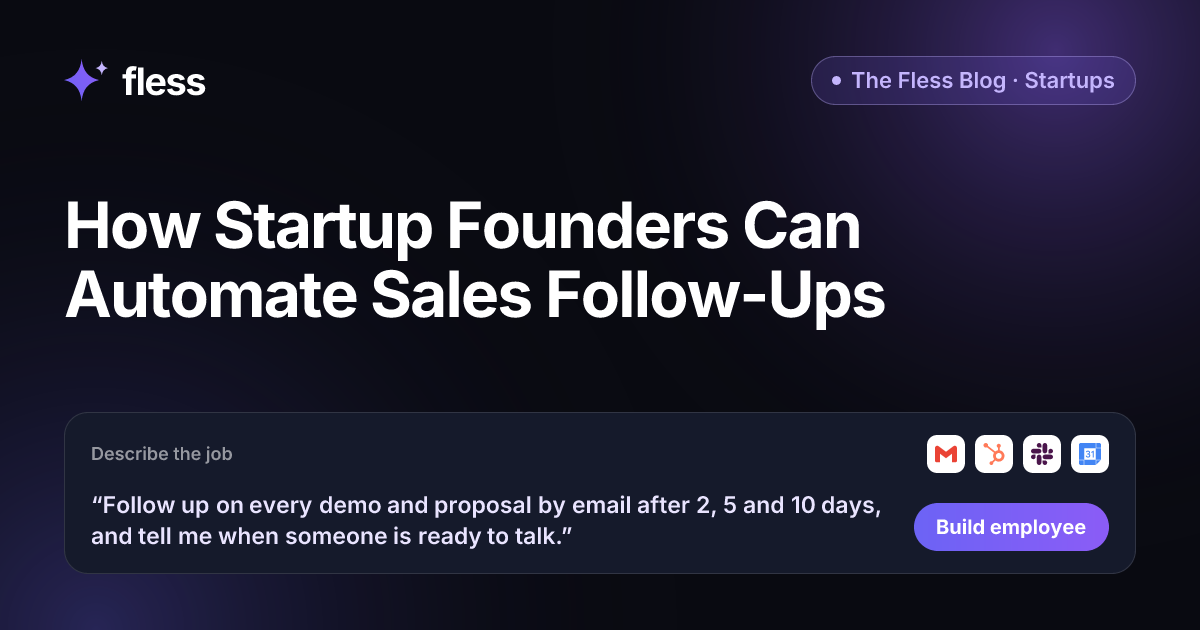
“Follow up on every demo and proposal by email after 2, 5 and 10 days, and tell me when someone is ready to talk.”
That sentence sets the trigger (every demo and proposal), the cadence (2, 5 and 10 days) and the hand-back (tell me when someone is ready). Fless works through Describe → Set up → Connect → Test → Go live, and shows each stage: understanding the job, designing the employee, picking apps and approvals, writing test conversations and checking it is safe.
Step 2: Start from the Follow-up Closer
Fless has a ready-made Follow-up Closer employee for sales. Out of the box, it follows up on every quote and proposal after 2, 5 and 10 days without a reply, with a short, friendly nudge by email or WhatsApp. It answers common questions about pricing and terms, tells you when someone is ready to sign, and needs your approval for any change to price or terms. Each Monday, it lists deals won, lost and still open.
Adjust it in plain English for your startup: demos as well as proposals, your tone, your common objections.
Step 3: Give it your sales knowledge
Paste your website and Fless learns your product in one click. Then add to the Knowledge base:
- Your pricing and what each plan includes.
- Answers to the five questions every prospect asks.
- Two or three short customer examples or use cases you are allowed to share.
- Your voice: "direct, warm, short. No buzzwords. Sign off as Tolu."
Step 4: Connect email, CRM and calendar
Connect Gmail so follow-ups come from your inbox, your CRM (HubSpot or Salesforce) so every touch is recorded, and Google Calendar so ready prospects can book a call. Add Slack if you want a message when a deal moves.
Step 5: Test it on last month's deals
In practice mode, nothing is really sent: actions are simulated. Give the employee last month's demos and proposals and see what it would have sent:
- A prospect who asked about security (does it answer from your knowledge?).
- A prospect who asked for a discount (does it come to you?).
- A prospect who replied "not now, maybe Q1" (does it stop and note it?).
- A prospect who replied "let's talk" (does it hand over and offer times?).
Step 6: Go live and read Monday's list
Once you are happy, go live. Every follow-up is logged and recorded in your CRM. Each Monday, you get a list of deals won, lost and still open, and your Chief of Staff can include sales in your daily brief.
Writing follow-ups that sound like a founder
- Reference the demo. "You mentioned your team re-enters orders by hand…"
- One idea per email. One answer, one example, or one question.
- Keep it under 80 words. Founders' emails get read when they are short.
- End with a simple question. "Worth a 15-minute call on Thursday?"
- Make it easy to say no. A clear no is better than months of silence.
Sales tools, sequences or an AI employee?
| Manual follow-up | Email sequence tool | AI employee | |
|---|---|---|---|
| Runs without you remembering | No | Yes | Yes |
| Personal to the demo | Yes, if you have time | Only with mail-merge fields | Yes, from your notes |
| Answers replies | You do | No | Common questions, by your rules |
| Stops and hands back at the right moment | You decide | On any reply | On any reply, with a summary |
| Updates the CRM | If you remember | Sometimes | Every time |
Why Fless for startup founders
- One sentence to build. Or start from the ready-made Follow-up Closer.
- Sounds like you. Learns your product from your website and your voice from your edits.
- Approvals for price and terms. Nothing about money changes without you.
- Practice mode first. Test on last month's deals before sending anything.
- Your stack. Gmail, HubSpot, Salesforce, Slack, Google Calendar and more.
- Marketing too. Marketing employees can run your launch calendar and social posts.
- A Chief of Staff. Daily briefs across every employee, free on every plan.
- Startup-friendly pricing. A Free plan to build and test, and paid plans from $39 a month plus usage, billed in USD, NGN, GBP, EUR, KES, GHS, ZAR or AED.
Fless is in beta, with public launch on Tuesday November 10, 2026. You can build an employee for any job today, in any department. See Fless for startups and pricing.
Count your silent deals
Look at every demo and proposal from the last 30 days. How many got a follow-up within two days? How many got a second one?
The gap is your pipeline. Write the follow-up job as one sentence and start using Fless. Your next "let me think about it" will get a timely, useful reply, even in the week you are fixing bugs.
Frequently asked questions
How do I automate sales follow-up emails as a founder?
Pick a simple cadence after each demo or proposal, write the tone you want, and give the job to an AI employee connected to your email and CRM. It sends short follow-ups, answers common questions, stops when the prospect replies, and tells you when someone is ready. On Fless, you describe the job in one sentence.
How many follow-ups should a startup send?
Three is a good default after a demo or proposal, for example after 2, 5 and 10 days. Make each one useful: a recap, an answer to a likely question, or a relevant example. Stop after the last one or as soon as they reply.
Won't automated follow-ups feel spammy?
Not if they are personal, short and few. An AI employee can reference what was discussed in the demo, answer real questions and stop when the prospect replies. Spam is generic and endless; good follow-up is specific and finite.
Can it update our CRM?
Yes. Fless connects to CRMs such as HubSpot and Salesforce, so every follow-up and reply is recorded and your pipeline stays current.
What should the founder still handle?
Pricing changes, custom terms, negotiation and the actual sales conversation once a prospect is ready. On Fless, any change to price or terms waits for your approval.
Is this available on Fless today?
Yes. Fless is in beta, with public launch on Tuesday November 10, 2026, and you can describe and build this employee today, like any other job.