Support
Multilingual Customer Support for African Businesses: Yorùbá, Pidgin, Swahili and More
Multilingual customer support with AI for African businesses: reply in Yorùbá, Pidgin, Hausa, Swahili, French and more, and test every language first.

· 6 min read
TL;DR
Multilingual customer support with AI lets African businesses reply to every customer in the language they actually write in, from English and Pidgin to Yorùbá, Hausa, Igbo, Swahili, French and Arabic, at any hour. Fless employees reply in the language the customer uses. The key is testing each language your customers use in practice mode, keeping sensitive topics with a person, and never assuming one language fits a whole market.
Three messages arrive at Bisi's bakery in Lagos within five minutes.
The first: "Good afternoon, please do you have red velvet for Saturday?" The second: "Abeg how much be the 2kg chocolate one?" The third, from an older customer: "Ẹ kú ọ̀sán o. Ṣé ẹ ní kéèkì fún ọjọ́ Àbámẹ́ta?"
Same question, more or less. Three different ways of asking. Bisi can answer all three, when there is time. Ada, Bisi's AI employee, can answer all three straight away, each in the language the customer used.
Meanwhile in Nairobi, Wanjiru's clinic gets booking requests in English, Swahili and Sheng, sometimes in the same sentence.
Across Africa, customers rarely speak to businesses in only one language. Multilingual customer support with AI lets a small business reply to everyone in the language they actually use, at any hour, without hiring a team for each language. Here is how to do it well.
Why language matters so much in support
- Customers write the way they speak. Pidgin, Sheng, Yorùbá greetings, French in Abidjan, Arabic in Cairo and Casablanca.
- Trust follows language. A reply in a customer's own language feels personal and respectful.
- Clarity reduces mistakes. Customers explain problems better in the language they think in.
- Many markets are multilingual. One city can need English, a local language and a lingua franca.
- Hiring for every language is hard. Small teams cannot staff every language at every hour.
Code-switching is normal, so plan for it
Many customers mix languages in one message, called code-switching:
| Example message | Languages |
|---|---|
| "Abeg, the cake wey I order, e go reach before 4pm?" | Nigerian Pidgin |
| "Niaje, nataka ku-book appointment ya kesho morning" | Sheng / Swahili with English |
| "Bonjour, c'est possible de livrer à Cocody today?" | French with English |
| "Ẹ kú àárọ̀, please is the shop open?" | Yorùbá greeting with English |
A good AI employee does not force everyone into formal English. It replies naturally in the style the customer uses, while keeping prices, dates and policies exact.
Which languages Fless works with
Fless employees reply in the language the customer writes in. For developers, the Fless docs list language settings for:
- English
- Nigerian Pidgin
- Yorùbá, Hausa and Igbo
- Swahili
- French, Arabic and Portuguese
- Spanish and German
Two honest notes. First, quality varies by language and topic, so always test the languages your customers use. Second, voice (phone) employees start in English, with more languages planned based on demand. Text channels such as WhatsApp, email and Instagram are where multilingual support works today.
How to set up multilingual support on Fless
Step 1: Describe the job in one sentence
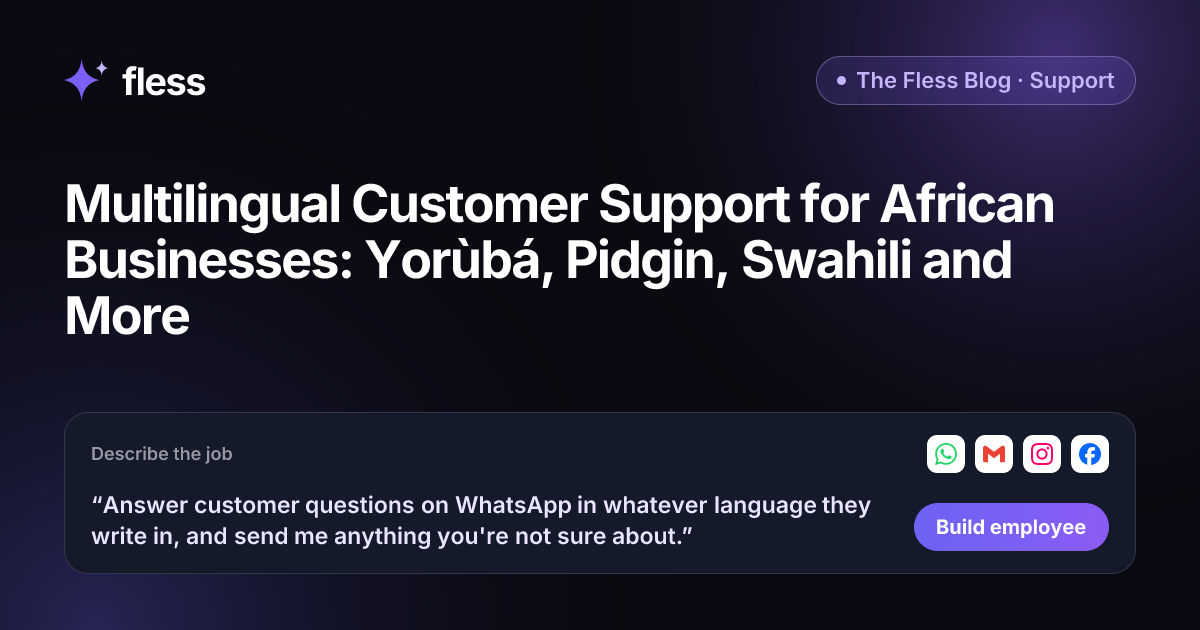
“Answer customer questions on WhatsApp in whatever language they write in, and send me anything you're not sure about.”
That sentence covers the channel (WhatsApp), the language rule (whatever the customer writes in) and the safety net (anything uncertain comes to you). Fless works through Describe → Set up → Connect → Test → Go live, and shows each stage: understanding the job, designing the employee, picking apps and approvals, writing test conversations and checking it is safe.
Step 2: Give it one source of truth
Paste your website and Fless learns your business in one click. Add your prices, policies and FAQs to the Knowledge base in one language, usually English. The employee answers from that knowledge in whichever language the customer uses, so you do not need to translate everything yourself.
Step 3: Write your language rules
Add short rules in plain English:
- "Reply in the language the customer uses, including Pidgin."
- "Keep prices, dates and order numbers exactly as written."
- "For refunds or complaints, reply in the customer's language and pass it to me."
- "If you are unsure what the customer means, ask politely rather than guess."
Step 4: Connect your channels
Connect WhatsApp, where most African customers message businesses; see AI employees on WhatsApp for how the connection works. Add Gmail, Instagram and Facebook if customers reach you there too.
Step 5: Test every language your customers use
This step matters more for multilingual support than for anything else. In practice mode, nothing is really sent: actions are simulated. For each language:
- Send five real customer messages from your history.
- Include at least one mixed-language message.
- Include one complaint and one price question.
- Ask a speaker of that language to read the replies.
If a reply sounds wrong, adjust the rules or knowledge and test again. If a language is not good enough yet for your customers, tell the employee to reply in English for that language and pass the message to you.
Step 6: Go live and spot-check
Once you are happy, go live. Every conversation is in the activity log. Each week, ask a speaker of each language to read a handful of conversations. Your Chief of Staff's daily brief shows what was handled and what is waiting for you.
Formality and respect, in every language
Language is not only words. In many cultures, how you address someone matters as much as what you say. Tell the employee how your business shows respect:
- Greetings first. Many customers expect a greeting before business, especially in Yorùbá, Hausa and Swahili.
- Respectful forms of address. For example, the respectful "ẹ" in Yorùbá for older customers, or "Mama" and "Mzee" where your customers use them.
- Match the customer's register. Relaxed Pidgin for a relaxed customer; formal English or French for a formal one.
Write these as short rules, then check them in practice mode with a native speaker.
What stays with a person
Language skill is not the same as judgment. Keep these with your team, in any language:
- Complaints and unhappy customers.
- Refunds, discounts and anything involving money beyond your rules.
- Health, legal or safety questions.
- Anything culturally sensitive, such as condolences or disputes.
The employee should acknowledge these kindly in the customer's language, then hand over with a short summary in yours.
One language, a phrasebook, or an AI employee?
| English-only replies | Translated templates | AI employee | |
|---|---|---|---|
| Customer can write naturally | Only in English | Partly | Yes, in their own language |
| Handles code-switching | No | No | Yes |
| Answers specific questions | Yes | Only scripted ones | Yes, from your knowledge |
| Works at night and weekends | Only if someone is awake | Partly | Yes |
| Knows when to hand over | Yes (it's you) | No | Yes, by your rules |
Why Fless for multilingual support
- Replies in the customer's language. Including Pidgin, Yorùbá, Hausa, Igbo, Swahili, French and Arabic.
- One knowledge base. Write it once; the employee answers in every language.
- Practice mode first. Test each language with real messages before going live.
- Approvals for sensitive topics. Money, complaints and anything you mark come to you.
- Built for African businesses. WhatsApp-first, Paystack payment links, and billing in NGN, GHS, KES and ZAR as well as USD, GBP, EUR and AED.
- NDPR and GDPR aligned. Your customers' data is not used to train models.
- A Chief of Staff. A daily brief on every conversation, free on every plan.
- Fair pricing. A Free plan to build and test, and paid plans from $39 a month plus usage.
Fless is in beta, with public launch on Tuesday November 10, 2026. Marketing employees can write posts in your audience's languages. See the Support department and pricing.
Listen to how your customers write
Scroll through last month's messages and list every language and mix your customers used. That list is your test plan.
Then write the job as one sentence and start using Fless. Every customer deserves a reply in the language they chose to write in.
Frequently asked questions
Can AI provide customer support in African languages?
Yes. Modern AI can understand and reply in many African languages, including Nigerian Pidgin, Yorùbá, Hausa, Igbo and Swahili, as well as French, Arabic and Portuguese used across the continent. Quality varies by language and topic, so test the languages your customers use before going live.
Which languages does Fless support?
Fless employees reply in the language the customer writes in. The Fless docs list language settings for English, Nigerian Pidgin, Yorùbá, Hausa, Igbo, Swahili, French, Arabic, Spanish, Portuguese and German. Voice (phone) employees start in English, with more languages planned based on demand.
What if a customer mixes languages in one message?
Code-switching, such as English with Pidgin or Swahili with Sheng, is normal. A good AI employee replies naturally in the mix the customer uses. Include mixed-language messages in your practice-mode tests.
Should the AI always reply in the customer's language?
Usually, yes. But set rules for exceptions: legal terms, prices and policies may need to be stated exactly, and some customers prefer English for formal matters. You can tell the employee how to handle these in plain English.
How do I check the quality of replies in a language I don't speak?
Ask a team member, friend or customer who speaks it to review a sample of practice-mode conversations before you go live, and spot-check the activity log regularly after.
Is multilingual support available on Fless today?
Yes. Fless is in beta, with public launch on Tuesday November 10, 2026, and you can describe and build this employee today, like any other job.