Company
From Sourzer to Fless: Why We Shut Down a Product 1,641 Recruiters Used
The Sourzer to Fless story: why we shut down an AI recruiting tool that reached 1,641 recruiters, and what it taught us about building AI employees.
· 5 min read
TL;DR
Before Fless, we built Sourzer, an AI tool for recruiters that reached 1,641 recruiters and 8,249 candidates. Sourzer had one fixed workflow, and every team asked for something different: they wanted to build and own their own. So we shut Sourzer down and built Fless, a platform where any team describes the job in plain English and gets an AI employee built for the way it works.
Shutting down something people use is one of the hardest decisions a founder makes. We made it with Sourzer. This is why, and why it led to Fless.
What Sourzer was
Sourzer was an AI tool we built for recruiters. It did one job, one way: it helped recruiters work through candidates using a workflow we designed.
It reached 1,641 recruiters and 8,249 candidates. For a small team, that was real traction.
Why one workflow made sense at first
Starting with one workflow is how most products are built, and for good reason. You pick a problem, you pick a way to solve it, and you ship. A focused product is easier to explain, easier to build and easier to improve.
The trouble starts when the product meets enough real teams. A workflow that fits the first users perfectly begins to fit the next ones a little less well, and the ones after that less still. That is what happened with Sourzer.
The message underneath the feedback
As more teams used Sourzer, a pattern kept appearing in what they asked us for. It was not about features. It was about shape.
Every team asked for something different. They did not want our workflow. They wanted to build and own theirs.
To see why, think about how differently two agencies can work:
| Agency A | Agency B | |
|---|---|---|
| Roles | High-volume retail hiring | Senior finance roles |
| Screening | Fast checks on availability and location | Deep review of qualifications and experience |
| Shortlist | Twenty people for a group interview | Three people for the partner to call |
| Scheduling | Batches of interviews on one day | One-to-one calls fitted around the client |
| Reporting | Daily numbers to the client | A written note on each candidate |
Same profession. Same broad goal. Almost nothing in common in how the work actually gets done. A single workflow, however good, would fit one of them and frustrate the other.
The hard decision
We had two options.
We could keep adding settings, toggles and special cases to Sourzer, trying to bend one workflow into hundreds. Every product team knows where that road goes: a tool that is complicated for everyone and right for no one.
Or we could accept what our users were telling us. The value was not in our workflow. It was in letting each team have its own.
So we shut Sourzer down and built Fless.
It was not an easy decision. Sourzer had users, and walking away from traction you worked hard for feels wrong. But keeping a product alive because it is hard to let go is not a good reason to keep it. Building what people were actually asking for was.
What we built instead
Fless is a platform where any team builds the AI employee it needs, by describing the job in plain English.
A recruiter who wanted Sourzer to work differently does not have to ask us anymore. They write the job the way they work:
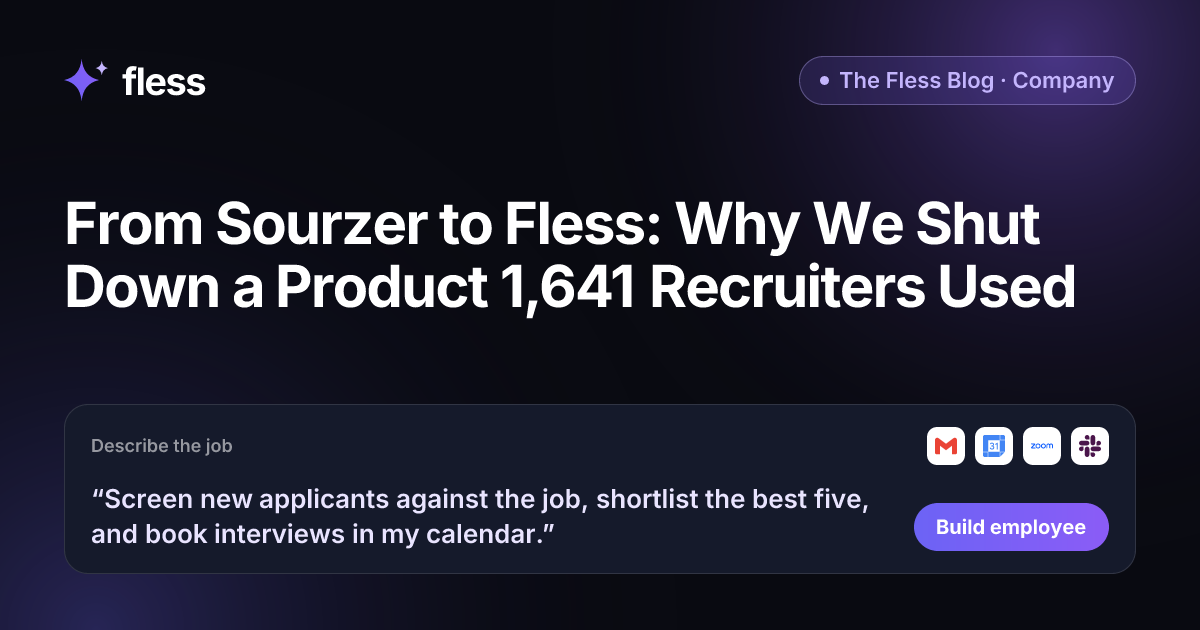
“Screen new applicants against the job, shortlist the best five, and book interviews in my calendar.”
Fless designs the employee, picks the apps and approvals it needs, writes test conversations, and checks it is safe before it goes live. Agency A writes a different sentence from Agency B, and each gets an employee built for the way it works.
And because Sourzer taught us that recruiting is not the only work like this, Fless is not only for recruiters. The same builder works for a bakery taking WhatsApp orders, a clinic booking appointments, a shop settling small refunds, or an agency planning a week of posts.
What Sourzer taught us
Three lessons from Sourzer shaped almost every decision in Fless:
- The people closest to the work know it best. So in Fless, they describe the job, not us.
- Fixed workflows break on contact with real teams. So Fless builds a new employee for each job instead of forcing every job into one shape.
- Trust comes from control. When software acts for you, you need to see and approve what it does. So in Fless, every employee is tested in practice mode first, sensitive actions wait for a person's approval, and every action is logged.
What has not changed
Some things carried straight over from Sourzer to Fless:
- A focus on real work, not demos. Every Fless employee is built to do a job end to end.
- Respect for the people on the other side, whether candidates or customers. Employees reply in the language people use, and humans stay in charge of the decisions that matter.
- A small team that ships. We would rather put something real in your hands and learn from it than talk about the future.
What I would tell another founder
If you are building a product and your users keep asking for something you did not design, these are the questions I would ask:
- Are they asking for features, or for a different shape? Features can be added. A different shape usually cannot be bolted on.
- Is your workflow the value, or is it in the way? If people love what your product does but not how it insists on doing it, the "how" might be the problem.
- Would you build the same product again today? If the honest answer is no, keeping it alive only delays the better one.
- Can you give users the power you have? We designed Sourzer's workflow. With Fless, we wanted the people closest to the work to have that same power.
None of this makes shutting something down easy. But it made the decision clear.
Who is building Fless
I have spent more than 12 years building and scaling software platforms in fintech and healthtech. I have been a founder and CTO twice, with two successful exits, Insurpass and Shopl, and Shopl was part of Techstars in 2022. Fless is a member of NVIDIA Inception.
Sourzer was the product that taught me the most, because it showed me the gap between what we thought people needed and what they kept asking for. You can read more about us.
What building Fless looks like day to day
The lesson from Sourzer runs through how we build Fless now. We start from the job someone describes, not from a feature list. We test every employee before it goes live, because a product that acts for people has to earn their trust. And we are open about what Fless can and cannot do, because we would rather under-promise than surprise anyone.
Why I am telling this story today
Fless launches publicly today. It felt right to be honest about where it came from: a product we shut down because our users were right.
If you used Sourzer: thank you. You told us what to build next.
If you are new here: describe the job that keeps slipping in your business, in one sentence, and start using Fless. Paid plans start from $39 a month plus usage, with a Free plan to begin. See pricing.
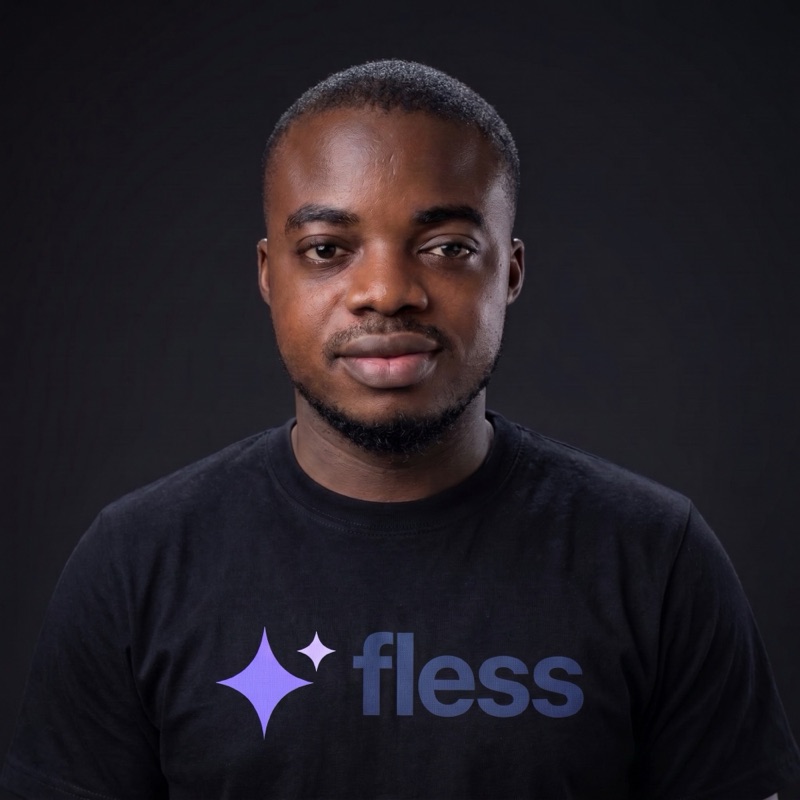
— Tobi, Founder of Fless
Frequently asked questions
What was Sourzer?
Sourzer was an AI tool built for recruiters, made by the team behind Fless. It reached 1,641 recruiters and 8,249 candidates, and it worked one fixed way.
Why did you shut down Sourzer?
Because every team asked for something different. Recruiters did not want our workflow; they wanted to build and own theirs. One fixed workflow could not serve them, so we stopped building Sourzer and built Fless instead.
How is Fless different from Sourzer?
Sourzer was one product with one way of working, for one profession. Fless is a builder: any team describes the job in plain English, and Fless builds, tests and runs an AI employee for that exact job, with approvals and an activity log.
Can recruiters build what Sourzer did on Fless?
Yes, and in their own way. Each agency describes its own screening and scheduling job.
Who is behind Fless?
Fless was founded by Tobiloba Odejinmi, who has more than 12 years of experience building and scaling software platforms, is a two-time founder and CTO with two successful exits, and was part of Techstars in 2022 with Shopl. Fless is a member of NVIDIA Inception.